
Why You Can't Stop Binge Eating — SVG Edition
It is not weakness. It is not a willpower problem. It is an ancient survival system hijacking your brain — and once you can see it happening, you can retrain it.
For ten years, Susan fought the same battle.
And for ten years, she lost.
She did not want to binge eat. She knew it was hurting her. She knew exactly how it would end — the shame, the regret, the physical discomfort, the emotional crash after the food was gone. She could have written the script in advance, because she had lived it a thousand times.
And yet, when the urge came, it ran her over anyway.
There was a voice inside her that said, "I do not want to do this."
And there was another force inside her screaming, "Go eat. You need this. Do it now."
Stop and look at that sentence. Two voices. One head. Pulling in opposite directions, at full strength, at the same time.
Most people never question this. They assume both voices are "me." Every thought, every craving, every demand, every emotional attack — all of it gets filed under one identity. Mine.
That assumption is the trap. We call it the default perspective.
The Instinctual Core Solution starts with a different question. What if the part of you that wants to stop is not the same part of you that keeps pushing you to continue? What if binge eating is not a failure of discipline at all? What if the urge is coming from an older system inside the brain — a survival system that is trying to protect you, and getting it catastrophically wrong?
That is where the Instinctual Core comes in.
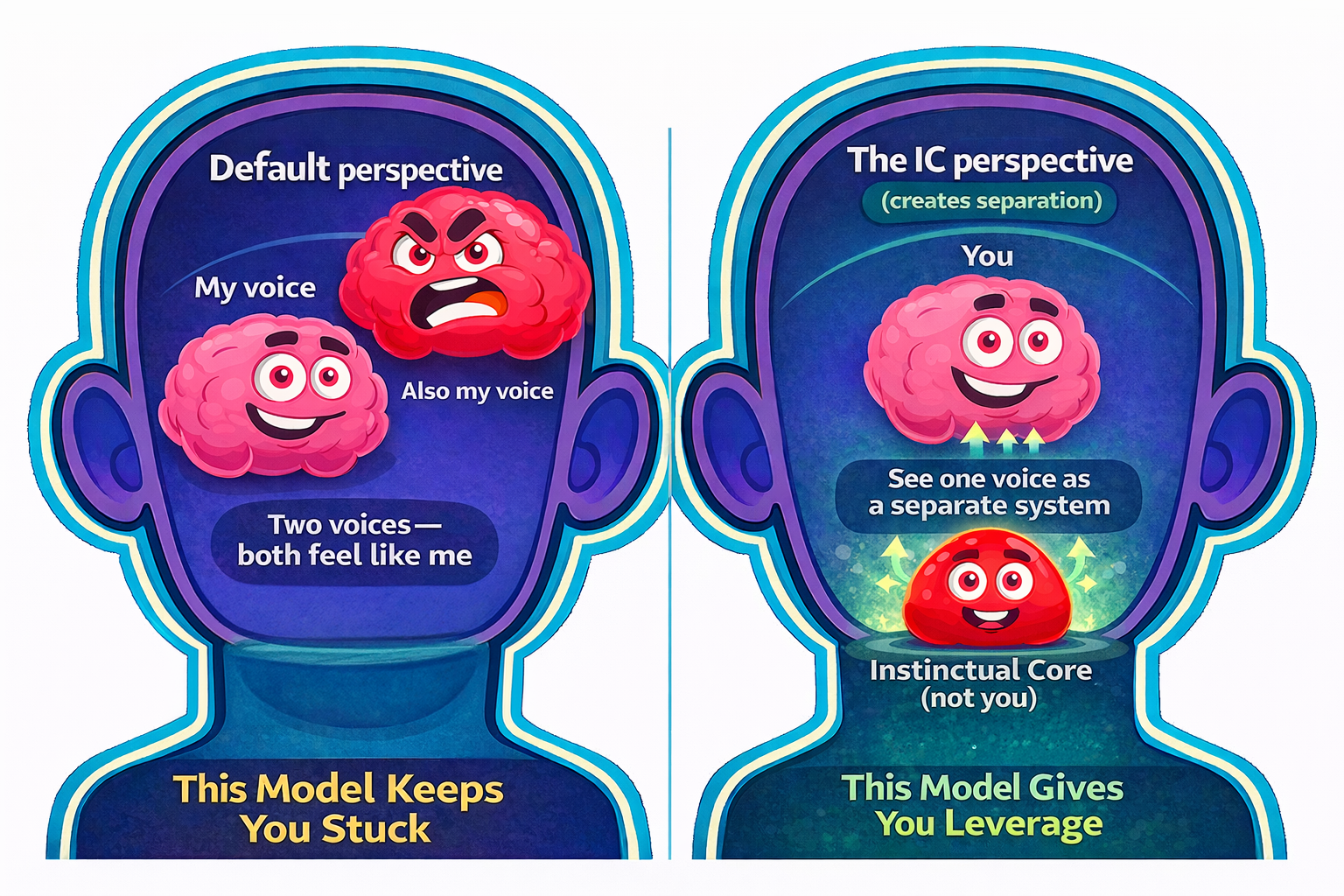
Look at the difference between those two heads.
The Left Head: The Default Perspective Keeps People Trapped
On the left, two voices, both labeled "me." That model gives you nothing to work with. If both voices are you, then fighting the urge means fighting yourself — a war you fund on both sides.
This is how it plays out. In the default perspective, whatever happens inside your mind is simply you. If you feel fear, you are afraid. If you feel shame, you are shameful. If a thought says "you are failing," that is your own verdict on yourself. And if you feel an urge to binge eat, then somewhere deep down, you must want to.
Stop and look at what that last one does. An urge shows up in your head — and instantly it gets treated as the truth about you. You never get to ask, "Where did this come from?" The default perspective has already answered: "This is what you really want. This is who you really are."
The urge is not evidence of who you are. But the default perspective makes it feel that way, every single time.
Susan lived inside that lie for years. When she grabbed the chips, she was going to finish the bag — both voices knew it. When she grabbed the cake, there was no such thing as one slice. The urge did not feel like a decision. It felt like pressure. It felt like a demand. It felt like something had taken the wheel.
Because something had.
And then came the cruelest part. Afterward, the same mind that had screamed for the binge turned around and prosecuted her for obeying.
First, the instinct-driven system pushes you toward relief. Then, when you take the relief, it attacks you for needing it. That is the cruelty of the cycle.
The system demands the behavior, rewards the behavior, and then punishes the behavior — and from inside the default perspective, every stage of that feels like you.
No wonder people conclude they are broken. They are grading themselves on a rigged exam.
The Right Head: The IC Perspective Gives You Leverage
Now look at the right head. Separation. One voice is yours. The other belongs to something else entirely.
Your conscious self — the real you — is the part that can reflect, observe, reason, choose, and plan. It is reading this sentence right now.
The Instinctual Core is the sum of your genetically coded survival instincts, running on the fast, automatic, subconscious brain. It is not evil. It is not broken. It is ancient. Its job description has exactly one line: keep this body alive. Not happy. Not fulfilled. Not proud of itself on New Year's Eve. Alive.
For tens of thousands of years, that system was magnificent at its job. It is the reason your ancestors survived ice ages, predators, famines, and each other. You exist because it worked.
But here is the problem, and it is not a small one.
Your Instinctual Core was built for a world that no longer exists.
It does not understand social media. It does not understand processed food. It does not understand modern loneliness. It does not understand that a picture on Instagram is not a tribal ranking report. It cannot understand that the craving for immediate reward might destroy the very life it is sworn to protect.
So it does the only thing it knows how to do. It fires signals.
Fear. Sadness. Stress. Cravings. Demands. Judgments.
And because those signals detonate inside your own head, in something that sounds exactly like your own voice, you assume they are you.
That is the mistake. That is the whole mistake.
And the way out is the right head: separation. You cannot win a war against yourself. You can absolutely retrain a confused survival system.
But that raises the obvious question: in any given moment, how do you know which voice is which?
That is exactly what the IC User's Guide is for.
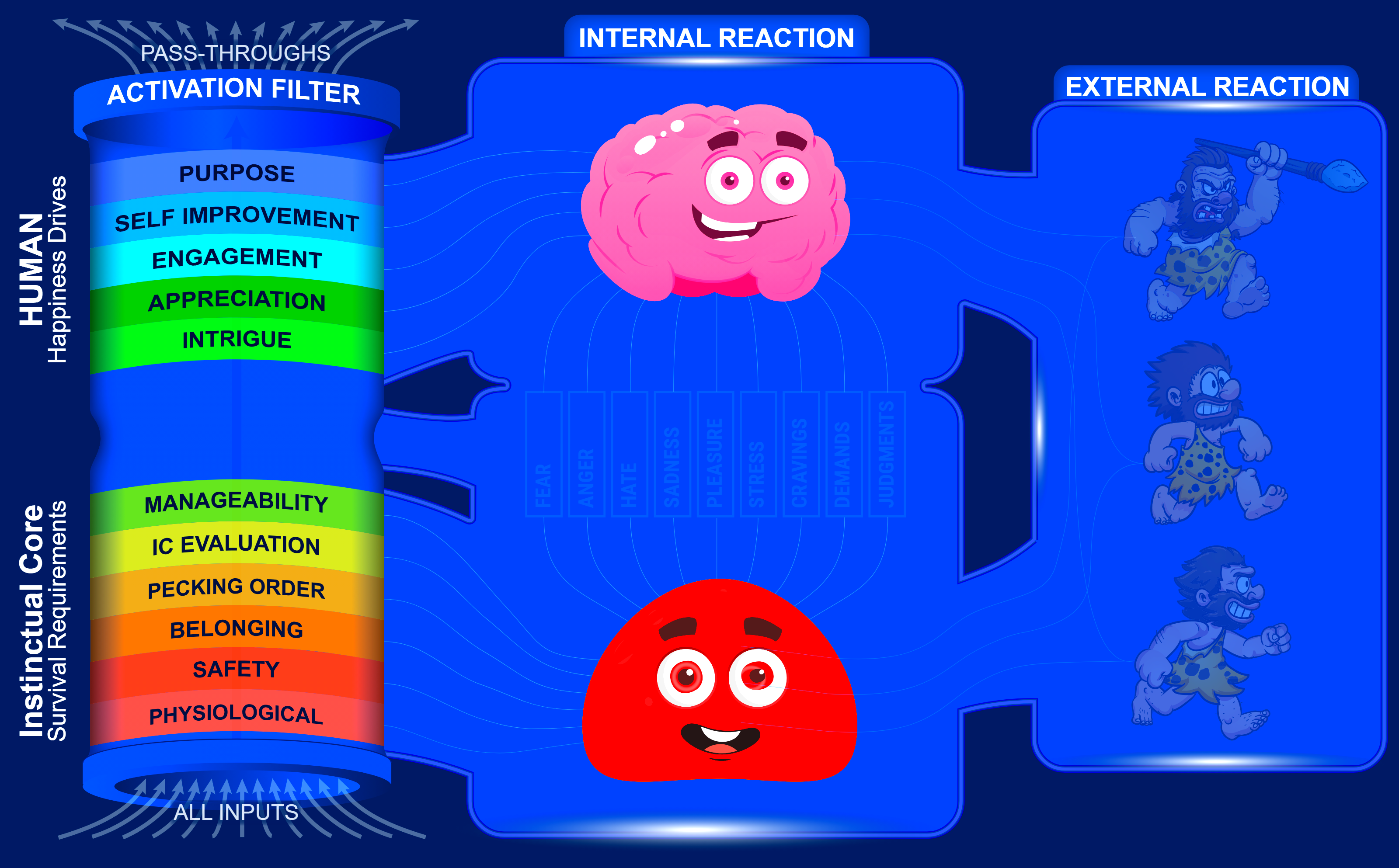
This is the map. The tower on the left is the Activation Filter — where everything in your life enters and gets screened for survival meaning. The red character is the Instinctual Core. The pink brain is you. The cavemen on the right are the external reactions the system can force: destroy the threat, avoid the threat, attain the treat. That is the IC's entire playbook — every push it will ever give you is one of those three, and it is always pushing one. It is that simple.
Now look at the arrows. Every input — every sight, sound, thought, memory, interaction — enters at the bottom of the filter and travels upward toward you.
Notice what that means. The Instinctual Core's survival layers sit at the bottom. Your human layers sit at the top. The IC gets first access to everything.
That is not an accident. That is the design. The IC runs on the fast, automatic, subconscious brain — it is dramatically quicker than your conscious mind. This is why we survived as a species. We would not be here without it.
Unfortunately, it is also dramatically dumber. So by the time an input reaches you, the IC has already screened it, already judged it, and — if anything pattern-matched to a threat or a treat — already fired the alarm.
The alarm goes off before you get a rational vote. Every time. That order of operations is the whole reason hijackings work.
Keep this map in mind. You are about to watch Susan's system light up.
Susan's Binge Eating Was Not Really About Food
On the surface, Susan's problem looked like food. Everyone — including Susan — was staring at the food.
The food was never the problem. The food was the painkiller.
Here is what was actually happening. Susan would feel terrible — overwhelmed, unloved, anxious, not good enough. Then food would offer immediate relief, and for a few minutes, it genuinely worked. The fear went quiet. The sadness softened. The pressure lifted.
Then the relief expired. The shame moved in. And the cycle reloaded.
This is one of the most misunderstood facts about binge eating: the binge is not creating the original pain. The binge is the brain's emergency response to pain coming from somewhere else.
In Susan's case, somewhere else had a name: the Belonging layer.
Her Instinctual Core was tracking love, acceptance, and social standing as if her life depended on them — because in the world that built it, her life did. Thirty thousand years ago, losing the love and protection of your tribe was not an emotional setback. It was a death sentence. The IC learned, over millions of years, to treat belonging as survival. That lesson is written into its code, and the code cannot be edited.
Now drop that ancient code into Susan's modern life.
Her Instinctual Core was not scanning a tribe of one hundred people. It was scanning social media. Celebrities. Influencers. Strangers. Filtered faces. Manufactured highlight reels. And it reached the only conclusion its ancient math allows:
"We are not loved enough. We are not admired enough. We are falling behind. This is an emergency."
So it declared war. It sent fear. It sent sadness. It sent cravings for love. It sent demands for approval. It sent judgments that she was failing.
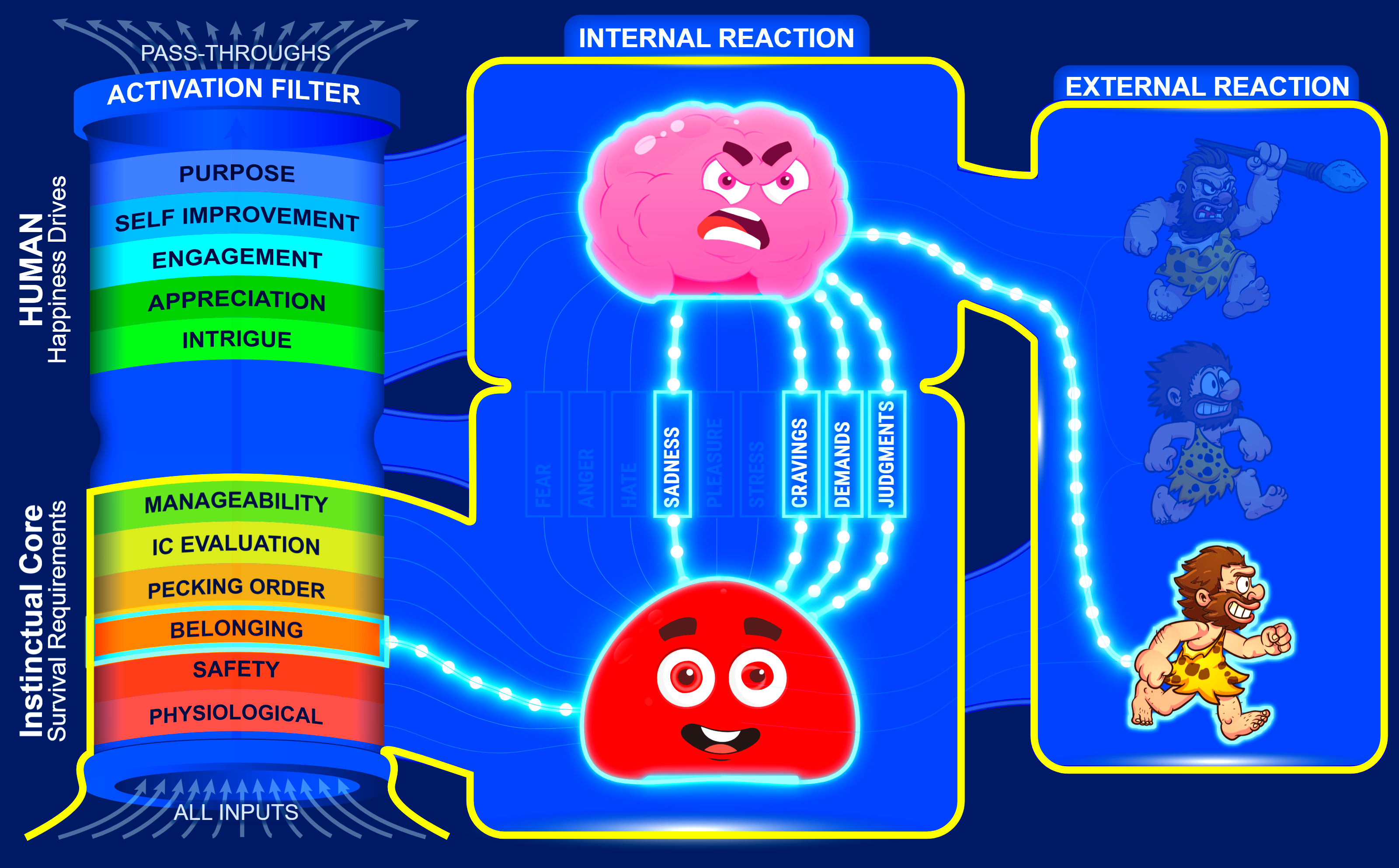
Look at what just happened in that diagram, because it is the single most important pattern in the IC Solution.
A survival requirement lit up in the Activation Filter. The Instinctual Core received the alarm. The IC launched its weapons into the brain. And the brain was driven into an external reaction it never consciously chose.
That complete chain has a name: a hijacking.
Every time you see that pathway — survival layer, to IC, to weapons, to brain, to behavior — you are not watching a person make a decision. You are watching a person get hijacked. Susan was hijacked like this thousands of times over ten years, and she never saw a single one happen.
Now here is the part that makes this trap so cruel.
In the prehistoric world, the Instinctual Core needed belonging from everyone — but "everyone" was a tribe of about one hundred people. That game was winnable. You could know every face. You could repair every rift. You could earn your place and feel it being earned.
Susan's Instinctual Core was still trying to win that game. Except now "everyone" was eight billion people — celebrities, influencers, strangers, filtered photos, and the manufactured highlight reels of the entire internet.
Her Instinctual Core was demanding an impossible scenario. Period.
There was no amount of approval, no number of likes, no level of acceptance that could ever satisfy it. The win condition no longer exists in the modern world.
Now think about what that means for Susan, hour by hour.
Sadness, cravings, demands, and judgments — firing nonstop, for a goal that cannot be reached. Alarm after alarm after alarm, and not one of them can ever be answered.
That is not discomfort. That is pain. Real pain.
And here is the thing you must understand about that pain:
The alarm was false. The pain was not.
A false alarm hurts exactly as much as a real one. The Instinctual Core does not have a volume knob for "this threat is imaginary."
Now put the default perspective back on. Susan did not experience this as "my survival system is firing false alarms." She experienced it as me. The sadness was her sadness. The judgment was her verdict. The pain was who she was.
And pain that is who you are cannot be questioned. It can only be relieved.
She had to make it stop. Anyone would.
That is the moment the trap springs.
Reward Confusion: When the Brain Looks for Relief in the Wrong Place
Here is the Instinctual Core's dirtiest secret, and the engine of nearly every addiction on earth:
A victory on one survival layer can temporarily shut off the alarms on a completely different layer.
Read that again, because it explains ten years of Susan's life.
Her Belonging layer was screaming — an unwinnable battle, alarms that could never be answered. But the IC does not need the right victory. It keeps score in neurochemistry, not in meaning. Any survival win, on any layer, gets counted.
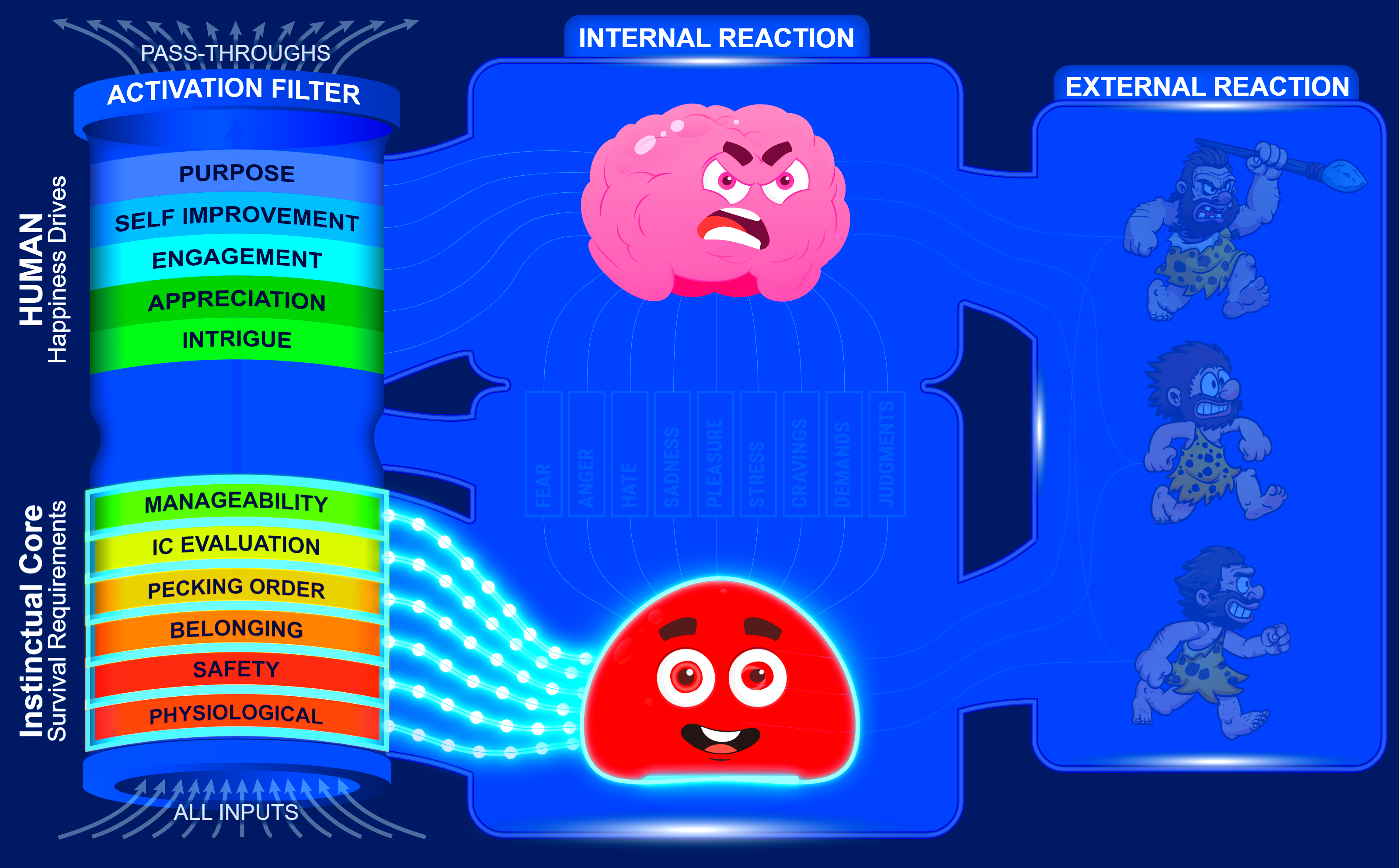
Watch what the IC is doing in that picture. Every layer lit up. Every door checked. It is not asking "what does Susan actually need?" It is asking one question only: where is the fastest available win?
And one layer always has a door that opens. Food is a victory on the Physiological layer. The oldest one. The most primal one. Calories secured — survival win.
So when Susan binged, two things happened inside her head, almost instantly.
First, the false alarms went silent. The sadness, the cravings, the demands, the judgments — the entire Belonging-layer siren system — shut off. After hours or days of nonstop pain, silence.
Second, the Instinctual Core sent pleasure. A chemical congratulations. "Victory. You did it. You survived."
Stop and feel the full weight of that. The binge did not just distract her from the pain. It turned the pain off and paid her a reward for doing it. Punishment lifted, pleasure delivered, in a single move.
That is reward confusion. And that is the trap, fully assembled:
An impossible goal creates endless pain. The pain demands relief. A false victory on a separate layer delivers that relief — instantly, reliably, chemically. And every time it works, the Instinctual Core stamps it deeper: this is how we survive.
For some people the false victory is alcohol. For others it is gambling, nicotine, scrolling, shopping, rage. The lever changes. The trap never does.
The Instinctual Core did not care that the food would hurt her tomorrow. The Instinctual Core does not have a tomorrow. It has now, and pain, and a lever that shuts the pain off. It pulled the lever.
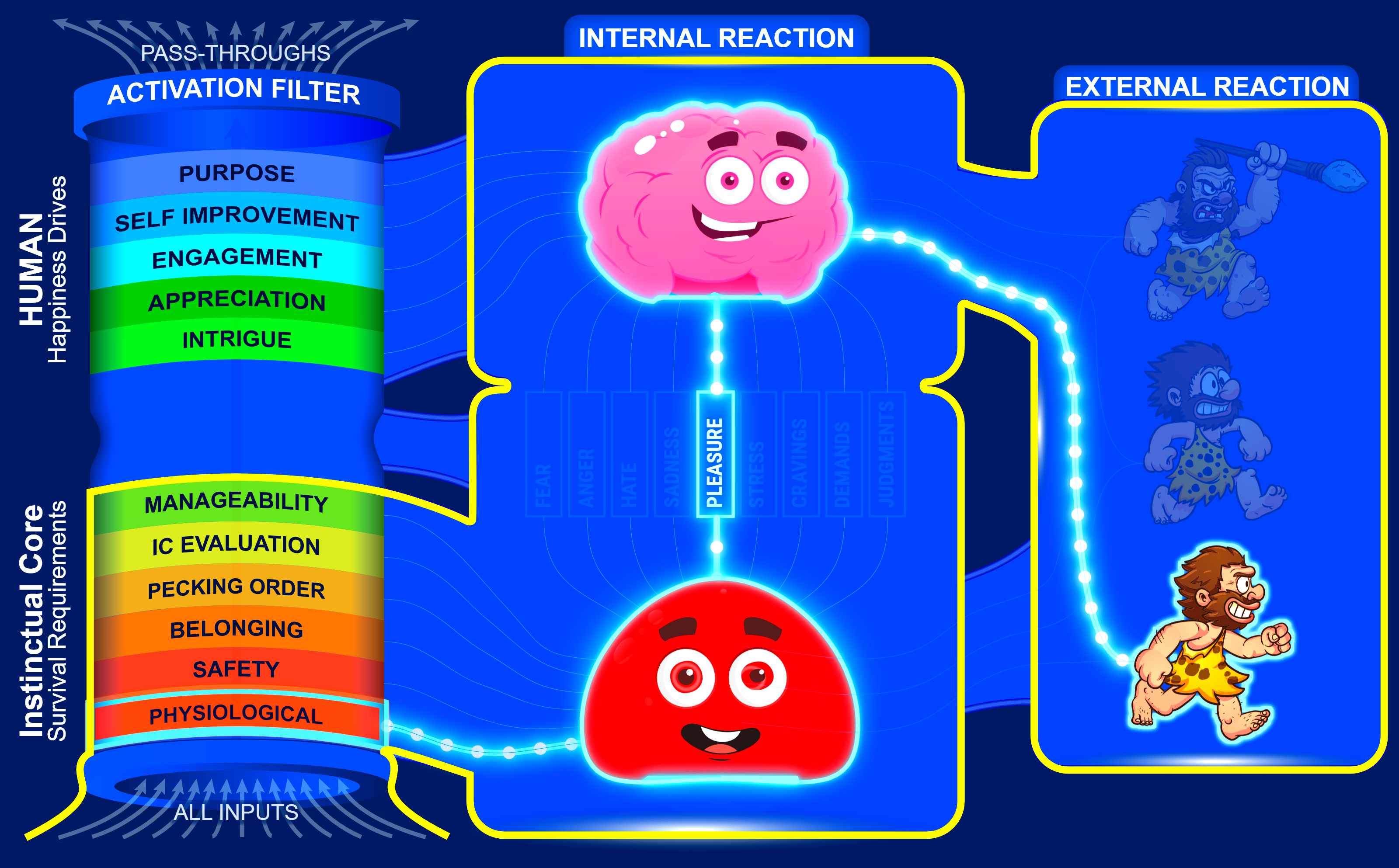
Look at the difference between this picture and every one before it. The belonging alarms — gone. The sadness, the cravings, the demands, the judgments — all faded to dark. One layer glowing: Physiological. One weapon firing: Pleasure. One happy face.
This is the most dangerous picture in the entire User's Guide. Because everything in it feels like the problem just got solved — and everything in it is the trap snapping shut. That yellow frame is still there. The chain still ran. Susan is still being hijacked. The only thing that changed is that this hijacking feels wonderful.
Susan was not failing to break the cycle. Her survival system was succeeding at maintaining it.
Why Willpower Always Breaks Down
Now you can see why willpower never had a chance — and why it was never a fair test of Susan's character.
Look at what willpower was actually being asked to do. Not resist a snack. Endure pain. Stand inside a body flooded with sadness, cravings, demands, and judgments — pain that felt like her own self screaming — and refuse the one lever that was guaranteed to shut it off.
Willpower can do that for a while. An hour. A day. A week. Susan once white-knuckled it for months. People around her called it progress. She knew better. She could feel the pressure building behind the dam.
Because willpower is a limited resource, and pain is not.
Willpower is a conscious-brain function. The Instinctual Core operates below consciousness. You are bringing a part-time defense to a full-time siege.
The survival brain does not get tired. It does not take weekends. It keeps the alarms screaming — every hour, every day — until the conscious brain runs out of fuel. Then the dam breaks. Then the binge. Then the shame.
And the shame is not a side effect. The shame is fuel. It pours straight back into the Belonging layer — "you are a failure, no one could love this" — which fires the next alarm, which starts the next round of pain, which demands the next relief.
This is why "just have more discipline" is not merely useless advice. It is a category error. Discipline asks a person to live in pain indefinitely. No one can. The person does not lack information, character, or strength. The person is in a trap — a trap built from real pain, false alarms, and a relief lever that always works.
You do not out-muscle a trap. You walk out of it.
The Breakthrough: "This Is Not Me. This Is My Instinctual Core."
Here is the strangest thing about the trap Susan lived in for ten years.
It had no walls.
The entire trap was built out of one belief: the pain is me. That single belief is what made the alarms unquestionable, the relief mandatory, and the cycle permanent. Remove the belief, and the whole structure loses its power.
Which means Susan did not have to fight her way out. She did not have to break anything, beat anything, or defeat anything.
She just had to walk out.
Her breakthrough was not a diet. It was not a meal plan. It was not a new level of self-control. It was a sentence:
"This craving is not me. This fear is not me. This demand is not me. This judgment is not me. This is my Instinctual Core — a totally separate entity that just happens to live in my head — sending a survival signal."
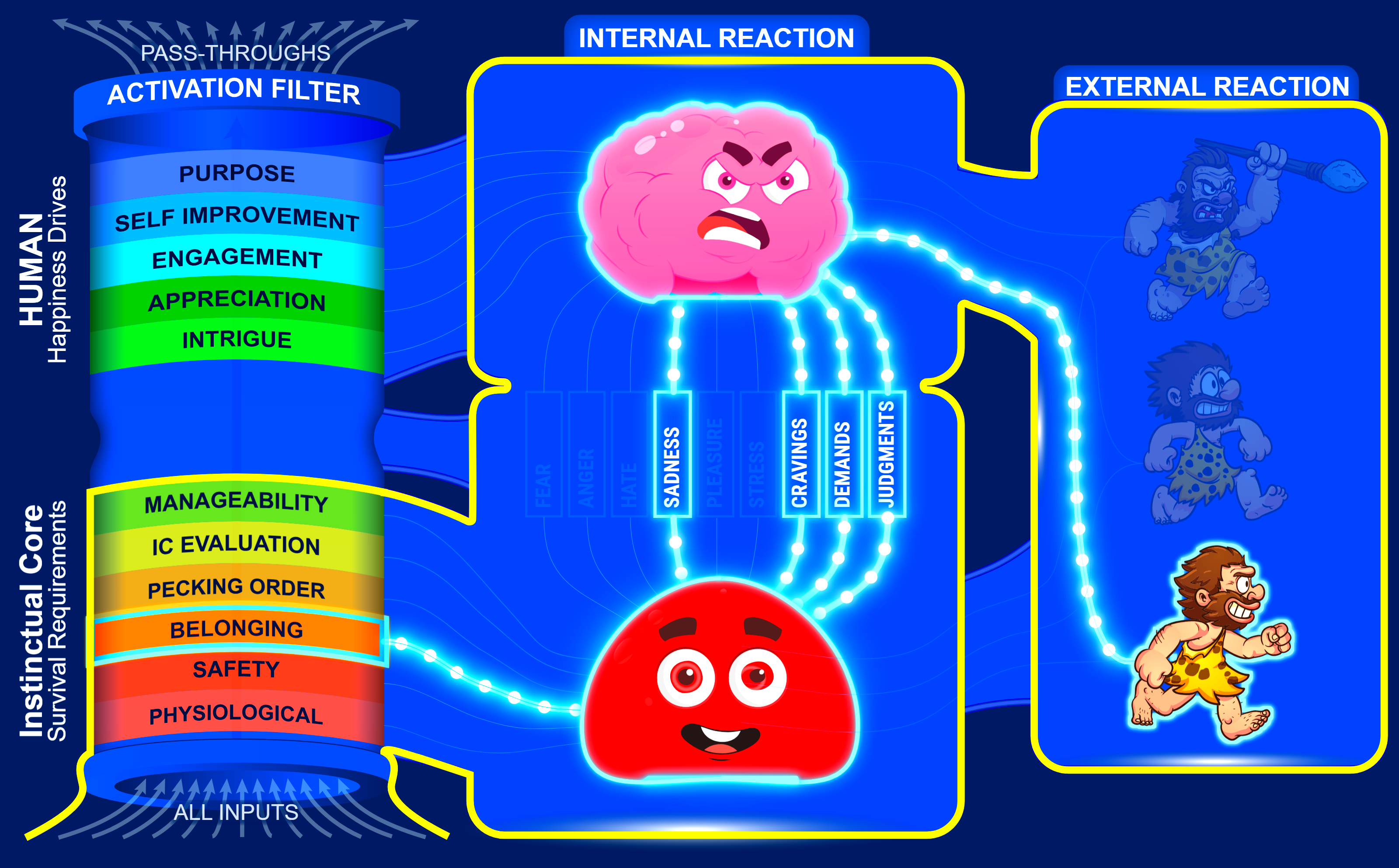
Look at that diagram and compare it to the one before it. Same layer firing. Same weapons launched. Same hijacking.
One thing changed: this time, she saw it.
That is the Aha. After ten years of being ambushed in the dark, Susan caught the system in the act. And the moment you catch it — the moment you watch a hijacking happen instead of starring in it — the entire geometry of the problem changes.
She was no longer fighting herself. There was no self-versus-self war anymore. There was a human, standing outside the trap, watching a separate survival system run an outdated program.
The pain still arrived. But pain that belongs to a false alarm is a completely different thing than pain that belongs to you. One is a verdict. The other is just noise from a confused machine — loud, yes, but no longer a command.
The signal still felt real. The craving still came. The pressure still rose. But now there was a gap — a half-second of daylight between the alarm and the obedience. And in that gap, for the first time in a decade, Susan had a choice.
"I know what this is. My Instinctual Core set off a false alarm that I need more love in order to survive. It is absolutely confused. I am just fine. The alarm is a mistake."
That gap is where every recovery begins.
Letting the Craving Pass Through
Here is what nobody tells you about instinctual signals: you cannot turn them off.
There is no switch. You cannot command a craving to dissolve. You cannot order fear back into its kennel. The Instinctual Core has been firing alarms for millions of years, and it is not going to stop because you asked politely.
But you do not need it to stop. That is the secret.
You only need to stop becoming the signal.
Susan learned to let the craving pass through without climbing inside it. Before, when the craving rose, she rose with it — if the Instinctual Core panicked, Susan panicked. The signal and the self were welded together.
The IC Perspective cut the weld. The craving rose. Susan watched it rise. The craving peaked and screamed for relief. Susan watched it scream. The craving — with nothing to grab onto, no panic to feed it, no obedience to confirm it — fell.
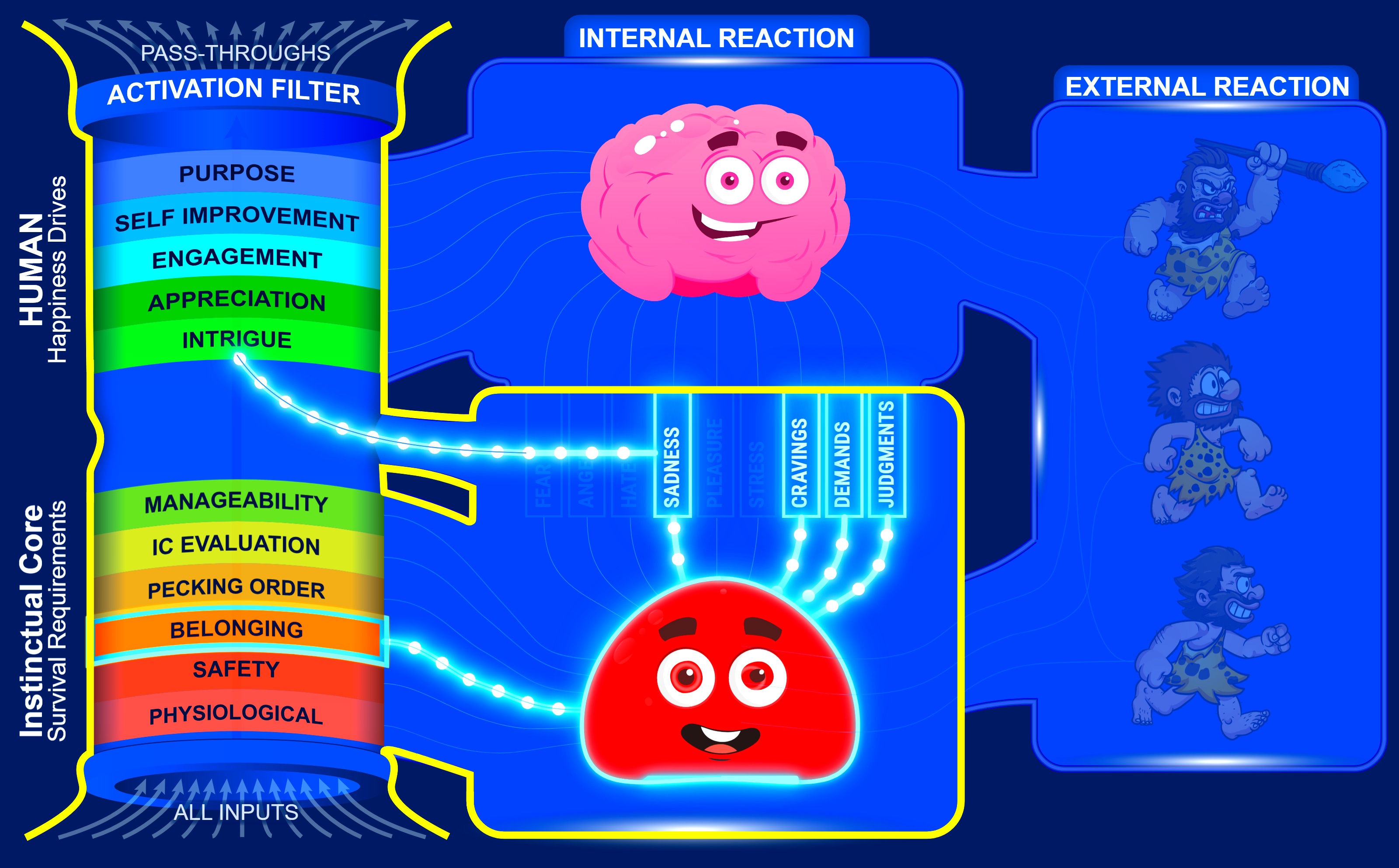
Look at the map now. The alarm still fires. The weapon still launches. But the chain is broken — the signal passes through the brain without commanding the body. No hijacking. No external reaction. The caveman stays home.
The craving was no longer proof that Susan was weak. It was just a signal — a loud, ancient, wrong signal — moving through a person who was no longer obeying it.
This is where the relationship changed for good. Because once the IC was a separate entity, Susan could do something you can never do with an enemy, but can always do with a confused animal in your care.
She could train it.
Think of a puppy that has learned that barking at the doorbell gets it a treat. The puppy is not bad. The puppy is running its programming, and the programming has been rewarded a thousand times. You do not cure that puppy by screaming at it, hating it, or shaming it. You cure it by calmly, consistently, not handing over the treat.
That became Susan's entire practice. Every time the IC popped up — every time a false alarm fired and the old begging began — she did the same thing. Notice it. Name it. "There it is. That's my Instinctual Core reacting to a false alarm." And then: no treat.
The first times were brutal. The puppy barked louder — the IC always escalates before it surrenders, because escalation has always worked before. But Susan had something now that she never had inside the trap: she knew the barking was not her.
And then the thing happened that happens to every puppy whose barking stops paying.
It barked less.
Each time the alarm failed to produce a binge, the Instinctual Core downgraded the strategy. Each pass-through was a training rep. Susan was not resisting her survival brain anymore. She was retraining it — patiently, repetition by repetition, teaching it the one lesson that ends the cycle:
"We do not need to binge eat to survive."
The Deeper Shift: From Needing Love to Giving Love
If the story ended there, it would be a good story. But it would be incomplete — because Susan would still be living inside the pressure that created the binges in the first place.
Stopping the false reward is half the work. The other half is dealing with the real hunger.
Remember what her Instinctual Core actually wanted. Not food. Belonging. And its strategy for getting belonging was pure survival logic: extract it. Get more approval. Get more validation. Be more liked. Monitor every face for evidence. Perform.
That strategy does not just fail. It backfires. It makes a person anxious, self-focused, and exhausting to be around — a transparent campaign for approval that pushes away the very connection it is desperate for. The IC's belonging strategy destroys belonging.
So Susan did the one thing her Instinctual Core would never think of.
She reversed the direction of the entire game.
Instead of trying to extract love, she started giving it.
And watch what happened inside the User's Guide when she did — because this is not just a nicer way to live. It is a different operating system. Sitting above the IC's survival stack, dormant through ten years of hijackings, are the five human happiness drives. When Susan reversed the game, they reactivated, one by one:
Intrigue — she got genuinely curious about people. Who are they? What is their story? Curiosity about others is impossible while the IC has you monitoring them for approval — and effortless once it stops.
Appreciation — she stopped scanning faces for evidence that she was liked and started scanning for things to appreciate. The exact same people, the exact same rooms — a completely different signal.
Engagement — she listened. Actually listened, not waiting-to-be-liked listened. She could be fully in the conversation because she was no longer running a background process about how the conversation made her look.
Self-Improvement — every interaction became a training rep: catch the IC, let the alarm pass through, stay present. She was getting measurably better at being herself.
Purpose — she stopped asking "do they approve of me?" and started asking "what can I add to their day?" The smallest purpose on earth, and it changed every room she walked into.
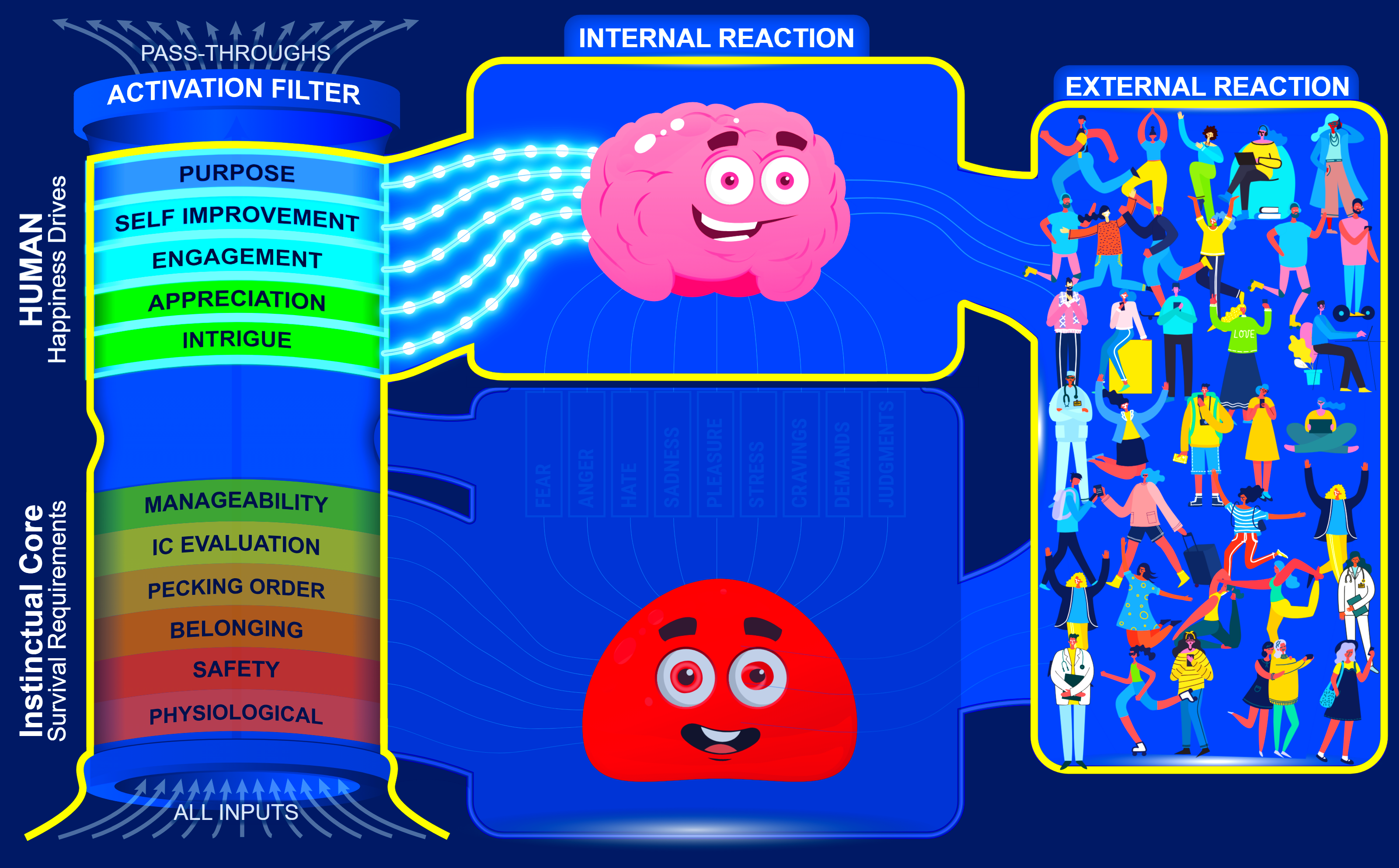
Look at the map one last time, because this is the picture the entire IC Solution is aiming at. The happiness drives are lit. The signal flows from the human side of the filter into the human brain — not from a survival alarm into a hijacking.
And look at what happened to the external reaction. The cavemen are gone. For the whole article, the only available outcomes were the IC's three survival moves — destroy, avoid, attain. Now the panel holds the full array of human life: connecting, creating, learning, playing, helping, building. The IC's playbook had three pages. Yours does not have a last page.
Trace the line: Susan is driving now. No alarm. No weapons. No yellow frame.
That is the difference between being driven and driving.
And here is the flip that ends the story. The belonging her Instinctual Core spent ten years failing to extract — the unwinnable game, the impossible scenario — Susan now receives as a natural byproduct of appreciating others. People relax around someone who is not campaigning. Connection grows where pressure used to be. The script is fully flipped: she stopped chasing belonging, and belonging started arriving on its own.
The emotional gap that had powered ten years of binges began to close — not because Susan won the IC's impossible game, but because she stopped playing it.
And when the real hunger faded, the false feeding lost its job.
A Different Question for Anyone Stuck in the Cycle
The traditional question is: "Why do I keep binge eating when I know I should stop?"
Ten years of that question got Susan nothing. It is a dead-end question, because it assumes the binge is the problem — and hidden inside it is an accusation: what is wrong with me?
The IC question is different: "What is my Instinctual Core trying to solve with this behavior?"
That question opens an investigation instead of a trial. Maybe the binge is not about hunger at all. Maybe it is about fear. Loneliness. Rejection. Maybe it is real pain from a false alarm — a survival system demanding immediate relief because it believes, wrongly and automatically, that something essential to your survival is missing.
To be clear: none of this makes the behavior harmless, and none of it replaces medical, nutritional, or professional support for those who need it. What it replaces is the verdict. The cycle stops being evidence of a defective character and becomes what it actually is — an instinctual pattern. And patterns, unlike character flaws, can be mapped, caught in the act, and retrained.
Not "what is wrong with me?"
"What is my survival brain trying to do — and why is it getting it so wrong?"
It Was Not Susan. It Was the Signal.
The most important thing Susan learned was not that food was bad. She had known that for ten years, and knowing it had saved her exactly zero times.
The most important thing she learned was that the urge was not her.
It was a signal. A loud one. A convincing one. A signal engineered by millions of years of evolution to be obeyed without question — and broadcast in a voice indistinguishable from her own.
But still a signal.
Once she could see the urge, she could stop obeying it. Once she stopped obeying it, it began to weaken. Once it weakened, the life it had been blocking for ten years was simply there — waiting for her.
The IC Perspective does not ask you to hate yourself into change. It does not ask you to shame yourself into discipline. Hate and shame are IC weapons — using them against the IC just feeds the machine.
It asks you to do something far more radical, and far gentler: walk out of the trap. See the Instinctual Core for what it is — a totally separate entity that just happens to live in your head, running survival code from a world that no longer exists. And then, every time it pops up reacting to a false alarm, train it like a puppy. Notice it. Name it. No treat.
Not a war. A training program. The IC always escalates before it surrenders — and then, rep by rep, it quiets down.
If you are stuck in a binge eating cycle — or any compulsive cycle — you have probably spent years asking "why am I so weak?"
Try the other question. Just once. The next time the urge rises, ask:
"What if this is my Instinctual Core trying to protect me with the wrong tool?"
Because the moment the craving stops being proof of who you are, it becomes something happening inside you. And what is happening inside you can be observed. What can be observed can be understood. What can be understood can be trained.
You are not the craving. You are not the shame. You are not the alarm screaming in your head.
You are the human who can learn to hear it — and stop letting it run your life.
Do Not Investigate Alone
Susan did not figure this out by herself, and you do not have to either.
Every day — at 7am, 12pm, and 3pm ET — people meet live to do exactly what you just watched Susan do: put their own patterns on the IC User's Guide, catch their hijackings in the act, and practice the separation together. It is free. You can turn your camera off. You can just listen. Nobody will ask you to speak, and nobody will shame you for the survival responses you developed — because everyone in the room has an Instinctual Core too, and every one of them is running the same ancient code.
There is something different about watching another person trace their trap on the same map you just learned. The pattern stops being your private shame and becomes what it actually is: the most common machinery in the human head.
Join a live IC meeting — today, free, no pressure to speak. Bring your pattern. We will help you investigate it.
Recognize this pattern in your own head?
Roger, the founder of Instinct Center, keeps a few 15-minute video call slots open every day. Free, no account needed, and nothing to prepare. Just pick a time.
Book a free 15-minute call with Roger →